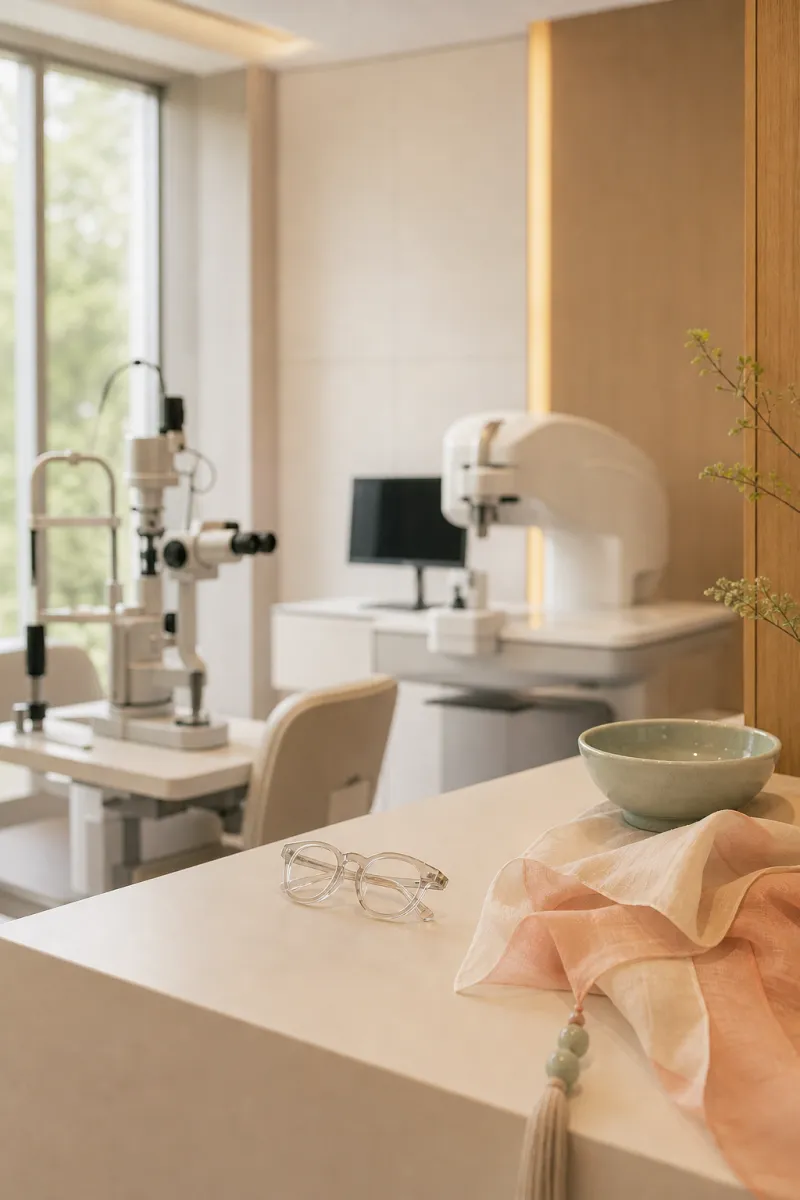
LASIK in Seoul is a same-day operation done under anesthetic eye drops: a thin flap is made in the cornea, an excimer laser reshapes the layer beneath it, and the flap is laid back without stitches. Both eyes are usually treated in one session. Whether you can have it is settled by the clinic's examination, so a visit is planned around that appointment, the surgery slot and the check on the following day.
Clinics in Seoul
10 clinics for Vision correction in Seoul
| # | Clinic | Devices & products | Area | Languages | Listed price | Google rating |
|---|---|---|---|---|---|---|
| 1 | Clear Seoul Eye Clinic | SMILE Pro · SMILE · LASIK · Presbyopia correction | Gangnam Station | English · Español · 日本語 · ไทย | ₩2,090,000 | 5.0 (328) |
| 2 | Raum Smile Eye Clinic | SMILE · LASIK · LASEK | Yeoksam Station | English · 中文 · 日本語 · Монгол | - | - |
| 3 | St. Mary's Jin Eye Clinic | SMILE · LASEK · ICL lens implant | Gangnam Station | English · 日本語 · 中文 · Монгол | - | 4.9 (107) |
| 4 | Share Bright Vision Eye Clinic (Gangnam) | SMILE · LASIK · LASEK | Gangnam Station | English | - | 4.7 (118) |
| 5 | SNU Eye Clinic | SMILE Pro · SMILE · LASIK | Sinsa Station | English · 中文 · Монгол · Русский | - | 4.8 (360) |
| 6 | GS Eye Center | SMILE Pro · SMILE · LASIK | Gangnam Station | English | - | 4.9 (593) |
| 7 | Gangnam EYEONCE Eye Clinic | SMILE Pro · SMILE · LASIK | Sinnonhyeon Station | English | ₩2,990,000 | 5.0 (259) |
| 8 | Gangnam Brand Eye Clinic | SMILE Pro · SMILE · LASIK | Nonhyeon Station | English · 日本語 · 中文 · Монгол | - | 4.9 (752) |
| 9 | B&VIIT EYE CENTER | SMILE Pro · SMILE · LASIK | Seoul | - | - | 4.9 (1,289) |
| 10 | EYEREUM Eye Clinic | SMILE Pro · SMILE · LASIK | Gangnam Station | English · Русский | - | 4.7 (215) |
 1
1. Clear Seoul Eye Clinic
★ 5.0328 Google reviewsClear Seoul Eye Clinic is a 2-minute walk from Gangnam Station Exit 10, a vision clinic with a 5.0 average from 328 Google reviews. It lists vision correction on its menu. It consults in English, Spanish, Japanese and Thai; listed vision correction prices start at ₩2,090,000.
Gangnam Station clinic for SMILE, cataract and presbyopia care
- SMILE & LASIK
- Cataract lenses
- Dry eye care
- The site covers SMILE Pro, Personal Eyes LASIK, same-day LASEK, ICL, cataract and glaucoma care.
- A Taiwan-facing version is linked from the language menu alongside Korean and English.
Cataract and presbyopia patients · Traditional Chinese speakers
- Location
- Gangnam Station Exit 10, 154 m (2-minute walk); Sinnonhyeon Station (Line 9 / Sinbundang Line) Exit 7, 10-minute walk
- Languages
- English · Español · 日本語 · ไทย
- Listed price
- From ₩2,090,000
 2
2. Raum Smile Eye Clinic
Raum Smile Eye Clinic is a vision clinic a 3-minute walk from Yeoksam Station Exit 3. Vision correction is on its menu. Consultations are available in English, Chinese, Japanese and Mongolian.
Gangnam eye clinic for SMILE, cataract and retina care
- SMILE & LASEK
- Three floors
- Five-language site
- Clinics listed include SMILE, vision correction, presbyopia and cataract, retina and glaucoma, and dry eye.
- The site is offered in Korean, Traditional Chinese, English, Japanese and Mongolian.
SMILE consultations · Traditional Chinese or Japanese speakers
- Location
- Yeoksam Station (Line 2) Exit 3, about 3 min walk; Gangnam Station (Line 2) Exit 1, about 5 min walk
- Languages
- English · 中文 · 日本語 · Монгол
3. St. Mary's Jin Eye Clinic
★ 4.9107 Google reviewsSt. Mary's Jin Eye Clinic sits a 5-minute walk from Gangnam Station Exit 5, a vision clinic that holds a 4.9 Google rating across 107 reviews. It lists vision correction on its menu. Consultations are available in English, Japanese, Chinese and Mongolian.
Gangnam eye clinic for cataract, SMILE and ICL surgery
- Cataract & retina
- English-speaking clinic
- Gangnam Station
- Care covers vision correction, cataract and presbyopia surgery, glaucoma screening, retina care and paediatric myopia control.
- The clinic recommends about one week in Seoul for cataract surgery.
Cataract surgery travellers · High myopia ICL candidates
- Location
- Gangnam Station Exit 5, 5-minute walk
- Languages
- English · 日本語 · 中文 · Монгол
4. Share Bright Vision Eye Clinic (Gangnam)
★ 4.7118 Google reviewsShare Bright Vision Eye Clinic (Gangnam) runs a vision clinic a 1-minute walk from Gangnam Station Exit 9; its Google rating is 4.7 from 118 reviews. Vision correction is on its menu. It consults in English.
Gangnam eye clinic for cataract, presbyopia and dry eye
- Cataract & presbyopia
- Dry eye care
- Multi-floor centre
- The clinic covers cataract, presbyopia, vision correction, dry eye, retina and oculoplastic care.
- The group also runs an Anyang clinic alongside the Gangnam clinic.
Dry eye treatment · Retina checks
- Location
- Gangnam Station Exit 9, 1-minute walk
- Languages
- English
5. SNU Eye Clinic
★ 4.8360 Google reviewsSNU Eye Clinic is by Sinsa Station Exit 4, a vision clinic with a 4.8 average from 360 Google reviews. It lists vision correction on its menu. It consults in English, Chinese, Mongolian and Russian.
Sinsa eye clinic for SMILE, ICL and cataract surgery
- SMILE & ICL
- International patients
- Sinsa Station
- The clinic says it has performed SMILE since 2011 and took part in early clinical research.
- The English site describes staff support for international patients.
SMILE candidates · Toric ICL candidates
- Location
- Sinsa Station Exit 4; Nonhyeon Station Exit 8 (158 m straight ahead) - per the Korean site
- Languages
- English · 中文 · Монгол · Русский
6. GS Eye Center
★ 4.9593 Google reviewsGS Eye Center is a vision clinic by Gangnam Station Exit 1, rated 4.9 from 593 Google reviews. Vision correction is on its menu. Staff consult in English.
Gangnam Station eye clinic for SMILE Pro and LASIK
- English support
- Same-day surgery
- Three floors
- The English site offers dedicated English support and same-day consultation and surgery for international visitors.
- It opens weekdays 10:00 to 18:30 and Saturdays 9:30 to 17:00, and closes on Sundays.
Same-day consultation and surgery · English-speaking visitors
- Location
- Gangnam Station Exit 1
- Languages
- English
7. Gangnam EYEONCE Eye Clinic
★ 5.0259 Google reviewsGangnam EYEONCE Eye Clinic sits a 3-minute walk from Sinnonhyeon Station Exit 9, a vision clinic that holds a 5.0 Google rating across 259 reviews. It lists vision correction on its menu. Staff consult in English; listed vision correction prices start at ₩2,990,000.
Sinnonhyeon eye clinic for SMILE, ICL and cataract care
- In-house interpreters
- Same-trip surgery
- Sinnonhyeon Station
- The English site says consultation, surgery and follow-up are handled by the operating surgeon.
- In-house interpreters cover English, Chinese, Mongolian and Thai, according to the English site.
High myopia or thin corneas · Non-Korean speakers
- Location
- Sinnonhyeon Station (Line 9 / Sinbundang Line) Exit 9, 3-minute walk
- Languages
- English
- Listed price
- From ₩2,990,000
8. Gangnam Brand Eye Clinic
★ 4.9752 Google reviewsGangnam Brand Eye Clinic runs a vision clinic by Nonhyeon Station Exit 4; its Google rating is 4.9 from 752 reviews. Vision correction is on its menu. It consults in English, Japanese, Chinese and Mongolian.
Gangnam eye clinic for SMILE, cataract and presbyopia surgery
- SMILE & cataract
- Retina & glaucoma
- Three-floor clinic
- The clinic names SCHWIND ATOS for SMILE and LENSAR for cataract and presbyopia surgery.
- Its Korean site covers SMILE, same-day LASEK, lens implantation, cataract, retina and glaucoma care.
SMILE and LASEK candidates · Retina or glaucoma checks
- Location
- Line 7 Nonhyeon Station (Exit 4 direction); Line 9 Sinnonhyeon Station (Exit 2 direction)
- Languages
- English · 日本語 · 中文 · Монгол
 9
9. B&VIIT EYE CENTER
★ 4.91,289 Google reviewsB&VIIT EYE CENTER is a vision clinic in Seoul, rated 4.9 from 1,289 Google reviews. It lists vision correction on its menu.
Gangnam Station centre for SMILE, ICL and cataract surgery
- Established 1994
- AI-assisted planning
- Same-day option
- Established in 1994, the centre performs SMILE Pro, SMILE, LASIK, LASEK, ICL and cataract surgery.
- An English-speaking coordinator supports international patients, and the site lists four foreign languages.
Thin corneas (LASEK) · English, Japanese, Chinese speakers
- Location
- Seoul
10. EYEREUM Eye Clinic
★ 4.7215 Google reviewsEYEREUM Eye Clinic is a vision clinic by Gangnam Station Exit 2, rated 4.7 from 215 Google reviews. Vision correction is on its menu. Staff consult in English and Russian.
Gangnam Station clinic for SMILE Pro, ICL and keratoconus
- SMILE & ICL
- Research-active
- Two-floor centre
- The site lists Low Energy SMILE pro, EVO+ ICL and Toric ICL, PresbyMAX and keratoconus care.
- The clinic publishes its conference presentations and research on lenticule extraction and ICL outcomes.
One-day surgery planning · Keratoconus patients
- Location
- Connected to the Gangnam Station Exit 2 underpass
- Languages
- English · Русский
Prices
Vision correction cost in Seoul
Prices below come from the listed clinics' own price lists. Vision-correction and cataract surgery are VAT-exempt medical care in Korea, so the listed price is the price you pay.
Premium One-day LASIK
Price at 1 listed clinic · approx. $1,520₩2,090,000Compare clinicsPresbyopia LASIK / LASEK
Price at 1 listed clinic · approx. $1,593₩2,190,000Compare clinicsSMILE LASIK (both eyes)
Price at 1 listed clinic · approx. $2,175₩2,990,000Compare clinicsGuide
How LASIK Differs From LASEK and SMILE
All three reshape the cornea to correct a refractive error; the difference lies in how the surgeon gets to the tissue. LASIK is the flap method. A thin flap is created, in current practice usually with a femtosecond laser, then lifted so an excimer laser can work on the layer underneath. LASEK and PRK are surface methods: the thin outer layer is loosened or removed and the excimer laser is applied from the top, with a soft bandage contact lens placed afterwards. SMILE cuts no flap and uses no excimer laser; a femtosecond laser outlines a small disc of tissue inside the cornea and the surgeon draws it out through a short incision.
The trade-offs follow from that. LASIK generally gives the quickest return of useful vision among the corneal laser procedures, and discomfort is typically mild and brief compared with surface treatment. The flap is also its particular weakness: an injury can displace it, which is why people in contact sports or jobs with a risk of eye trauma are often steered toward a flap-free option. LASIK can treat myopia, hyperopia and astigmatism within device limits, while SMILE is used for myopia and myopic astigmatism.
Labels such as wavefront-guided, wavefront-optimized and topography-guided describe how the laser pattern is planned. They are versions of LASIK planning, not separate operations. The treatment page covers the procedure in more depth.
Guide
Who Usually Qualifies, and Why Some People Are Turned Away
LASIK is often considered for adults whose prescription has stopped changing and whose corneas are thick enough and even in shape. Those two corneal conditions most often decide the matter. An abnormal corneal map, a thin cornea, too little tissue left under the flap, young age and high myopia are documented risk factors for ectasia, a progressive weakening and bulging of the cornea that is rare but serious.
The share of corneal tissue changed by the flap plus the laser treatment is linked with ectasia risk too, even when the map taken before surgery looks normal. So a strong prescription on an average cornea can be declined for LASIK and still be assessed for a surface method or SMILE, each with its own criteria. Marked dry eye before surgery is a further reason for caution, and an operation is usually put off during pregnancy and breastfeeding or while an eye is infected or inflamed.
None of this can be judged from a prescription slip. Treat any answer you receive before the scans as provisional.
Guide
A LASIK Seoul Visit, Stage by Stage
A trip for LASIK has a fixed backbone: lenses out, examination, surgery, next-day check. Everything else, including how many nights you book, hangs on the clinic's timetable and on how your eyes respond, so ask for the schedule in writing instead of relying on a number from a forum.
Some clinics run the examination and the operation on one day for people who qualify. That is convenient, but a visitor cannot count on it: the scans may point to a different procedure, or to no surgery. Bring your current glasses, older prescriptions if you have them, a list of your medicines and records of any earlier eye surgery.
Flying is not limited by cabin pressure, because LASIK leaves no gas in the eye. The limit is the check schedule, and the surgeon decides when you may travel. Cabin air is dry, so keep lubricating drops and your prescribed drops in hand luggage.
| Stage | What happens | What to settle beforehand |
|---|---|---|
| Before you book flights | Contact lenses are left out so the cornea returns to its own shape | The break differs by lens type and by clinic; get the clinic's figure for your lenses first |
| Examination visit | Refraction, corneal thickness, corneal map, pupil size, tear film, eye pressure and a dilated retinal check | It takes a few hours and dilating drops blur near vision afterwards; keep the day clear |
| Surgery session | Flap, excimer reshaping, flap repositioned; you leave the same day with shields and drops | You should not drive; ask whether surgery can follow the examination on the same day |
| Following day | The first check, standard after LASIK | Hold off on onward travel until the surgeon has seen the eyes |
| After you leave | Drops continue and further checks fall over weeks to months | Line up an eye doctor at home and carry a written surgical record |
Guide
Side Effects to Weigh Before Committing
Dry eye is the most common side effect after LASIK. It usually eases over months, though it can persist in some people. The subject has its own literature: Toda reviewed dry eye after LASIK in Investigative Ophthalmology & Visual Science in 2018. If your eyes already feel dry with contact lenses or long screen days, say so at the examination so the tear film is assessed with that in mind.
Glare, halos, starbursts and double images around lights can appear, particularly at night. Flap problems are uncommon with femtosecond flaps but do occur: an incomplete or irregular flap, folds, displacement, surface cells growing under the flap edge, or inflammation in the layer beneath it. The correction may land under or over the target or drift back, and a second treatment is offered only if enough cornea remains. Infection is rare but possible.
Long-running audits show how much recorded experience exists with the operation in this part of the world. Yuen and colleagues published a 10-year prospective audit of LASIK outcomes for myopia covering 37,932 eyes at a single institution in Asia, in Ophthalmology in 2010. An audit describes one center's record; it does not predict yours. No surgeon can promise a specific level of vision, a life without glasses, or that reading glasses will not be needed with age.
Guide
Reading the Clinic List and Price Table Here
The clinic list on this page shows what each clinic states about itself; use each clinic card as a starting point for questions, not as a verdict. The useful questions for a LASIK visitor are narrow ones. How is the flap made? Which planning method is being proposed, and why? Who operates, and who sees you the next morning? What happens if the scans rule LASIK out?
The price table shows listed prices for the procedures the clinics publish. A listed price is the price; what differs between clinics is what sits inside it. People who search for LASIK cost in Korea will find how to read those lines on the price page, and the clinic-choosing page sets out the checks to run before picking one.
Searches for LASIK eye surgery in Korea, Korea LASIK surgery or LASIK in South Korea all lead to the same operation. Clinics in Seoul differ from one another in devices, program names and follow-up arrangements, not in what LASIK is.
Guides
Guides on this site
Evidence
Research behind this page
- Dry Eye After LASIKInvestigative Ophthalmology & Visual Science · 2018 · doi:10.1167/iovs.17-23538
A review article on dry eye after LASIK.
- A 10-Year Prospective Audit of LASIK Outcomes for Myopia in 37932 Eyes at a Single Institution in AsiaOphthalmology · 2010 · doi:10.1016/j.ophtha.2009.10.042
A prospective audit of LASIK outcomes for myopia over 10 years at a single institution in Asia.
FAQ
Questions about Vision correction in Seoul
Which clinics offer Vision correction in Seoul?
Clinics offering Vision correction in Seoul include Clear Seoul Eye Clinic (Gangnam Station), Raum Smile Eye Clinic (Yeoksam Station), St. Mary's Jin Eye Clinic (Gangnam Station), Share Bright Vision Eye Clinic (Gangnam) (Gangnam Station) and SNU Eye Clinic (Sinsa Station). Each lists Vision correction on its own menu; message the clinic directly to confirm the doctor, product and current price.
Can the examination and LASIK in Seoul happen on the same day?
Some clinics offer both on one day for patients who qualify, but you should not build a trip that depends on it. The examination takes a few hours and includes dilating drops, and its result may be a different procedure or advice not to operate. Contact lenses must also have been out for the period the clinic requires before the measurements. Ask whether same-day surgery is the clinic's normal practice for visitors.
Why do I have to stop wearing contact lenses before the scans?
Lenses press the cornea into a slightly different shape, and the laser plan is calculated from that shape. Leaving them out lets the surface settle before it is measured. The length of the break depends on the lens: soft lenses need the least time, toric soft and rigid gas-permeable lenses more, and overnight orthokeratology lenses the most. Each clinic sets its own periods, so get the figure for your lens type in writing before you buy flights.
What does the flap mean for everyday life after LASIK?
The flap is laid back without stitches, and the main practical point is that an injury to the eye can displace it. That is why protective shields are worn at night early on and rubbing the eyes is off limits, and why people who box, play contact sports or work where eye trauma is likely are often advised to look at a flap-free method. Mention your sport or job at the examination; it is part of choosing between LASIK, a surface method and SMILE.
Is LASIK or LASEK the quicker option for a short trip?
LASIK generally allows the shorter stay of the two. Useful vision tends to return fastest after LASIK, and the first check is the next day. After LASEK the surface needs several days to close, with pain, watering and blur expected, and the clinic removes the bandage contact lens once it has healed. Speed does not decide suitability, though. If your cornea is thin for a flap, a surface method may be the laser option you are offered, and the trip has to stretch to fit it.
What will my eyes feel like in the first days after LASIK?
Most people have mild, short-lived discomfort, and many see well by the next day, though this varies. Vision can fluctuate for some weeks while the surface of the eye recovers, and dryness is common early on. You go home with protective shields and eye drops and should not drive on the day. Avoid rubbing the eyes, and keep away from pools, saunas and eye make-up for as long as the clinic instructs.
Can LASIK correct astigmatism or farsightedness?
Yes, LASIK can correct myopia, hyperopia and astigmatism, each within the limits of the device being used. Those limits, and the amount of tissue the correction would remove, are checked against your corneal thickness at the examination. A prescription inside the device range can still be declined if too large a share of the cornea would be altered. Standard LASIK does not stop the age-related loss of near focus, so reading glasses may be needed later.
Who follows up on my eyes once I am back home?
You will need an eye doctor at home for the checks that fall after you leave, since they are spread over weeks to months. Before departure ask the clinic for a written surgical record with the treatment data, the complete course of eye drops and written instructions. Ask as well how an enhancement or a complication would be handled for someone living abroad, because clinics set their own policies.
Will I need a second LASIK treatment later?
Some people do, because the correction can come out under or over the target or regress over time. A second treatment, called an enhancement, may be offered if the cornea has enough tissue left, and that cannot be promised in advance. For a visitor the practical questions are who would perform it, whether it would mean another trip and on what terms. Get the clinic's answer in writing before the first operation.
Does wavefront-guided or topography-guided LASIK mean a different surgery?
No, both terms describe how the laser pattern is planned, not a different operation. Wavefront-guided, wavefront-optimized and topography-guided treatments all use the same flap-and-excimer sequence. Which plan is proposed depends on your measurements and on the clinic's equipment. When two clinics name different planning methods, ask each one to explain why that plan fits your eyes and which device will deliver it.